

If there’s one area many people—especially women—want to improve, it’s the glutes. A firm, round, strong backside isn’t just about aesthetics either; strong glutes support better posture, improved athletic performance, and healthier hips and knees. Yet despite endless “booty burn” videos and light-band circuits, many still struggle to see real change.
This workout approach cuts through the noise. It’s rooted in heavy, purposeful training, built on fundamentals rather than gimmicks. The philosophy is simple: if you want to build muscle and shape your glutes, you need to challenge them properly—and give them time to recover.
Why Heavy Training Changed Everything
For a long time, there was a common belief that lifting heavy weights would make women bulky. That myth kept many stuck doing light weights, endless reps, or bodyweight-only leg days. The result? Legs that stayed lean, glutes that stayed flat, and progress that stalled.
The turning point comes when you realize that muscle growth requires stimulus. When heavier loads and higher volume are introduced—with good form—the body adapts. Muscles grow, strength improves, and shape follows.
Heavy training doesn’t mean reckless lifting. It means choosing weights that are challenging but controlled, focusing on compound movements that recruit multiple muscle groups at once. These movements don’t just work the glutes in isolation; they create a full lower-body stimulus that leads to balanced, athletic development.
Keep It Simple: The Power of Compound Lifts
At the heart of this glute-focused routine are foundational exercises. These movements have stood the test of time for a reason—they work.
- Squats are the cornerstone. When performed correctly, they engage the glutes, quads, hamstrings, and core all at once.
- Deadlift variations, particularly straight-leg or Romanian deadlifts, emphasize the hamstrings and glutes while reinforcing proper hip hinge mechanics.
- Pressing and stepping movements like lunges and step-ups add unilateral work, helping correct imbalances and further activate the glutes.
Rather than bouncing from machine to machine, this approach prioritizes barbells and dumbbells. Free weights demand more from your stabilizing muscles, making each rep more effective. Machines still have a place, but they’re accessories—not the foundation.
A Once-a-Week, High-Impact Approach
This workout is designed to be done once per week—and for good reason. The volume and intensity are high enough that your legs and glutes need several days to recover fully. When done properly, soreness is almost guaranteed, and strength gains follow shortly after.
The session typically lasts 45–60 minutes, striking a balance between efficiency and effectiveness. Rest periods are intentionally kept short, usually between 60 seconds and two minutes. This keeps the muscles under tension, increases metabolic stress, and drives adaptation.
The Workout Structure
Here’s how the Butt Builder workout comes together:
1. Squat and Leg Curl Superset
This pairing is the backbone of the routine. Performing squats immediately followed by leg curls pre-exhausts and fully engages the posterior chain.
- Squats: 10 sets of 10 reps
- Leg curls: 10 sets of 10 reps
- Rest: 60 seconds between supersets
By the time you finish this section, your legs should feel thoroughly worked.
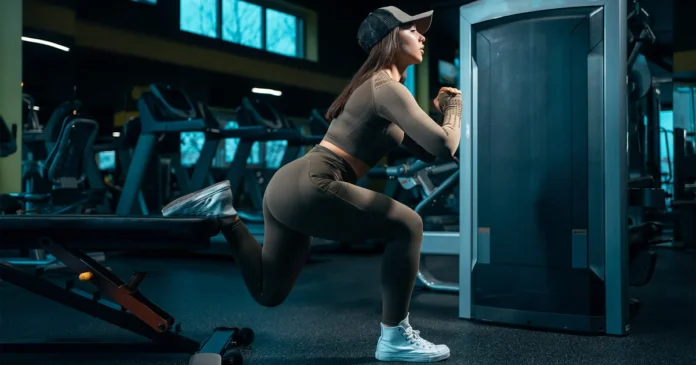
2. Reverse Barbell Lunges
Stepping backward into a lunge places more emphasis on the glutes and reduces stress on the knees.
- 4 sets of 8–10 reps per leg
3. Dumbbell Step-Ups
A simple but brutally effective movement. Focus on driving through the heel of the working leg and controlling the descent.
- 3 sets of 12 reps
4. Leg Extensions (Finisher)
While machines aren’t the focus, leg extensions are used here to completely fatigue the lower body.
- 3 sets to failure
The key throughout the workout is this: use the heaviest weight you can manage without sacrificing form. Sloppy reps don’t build better glutes—they increase injury risk.
Nutrition: Fueling Growth and Recovery
Training hard is only half the equation. Nutrition plays a major role in how your body responds.
On leg training days, increasing carbohydrate intake can be beneficial. Adding an extra 50–75 grams of starchy carbs helps fuel the workout and supports recovery. Post-workout, a whey protein shake is a convenient way to kickstart muscle repair. Some athletes include fast-digesting carbs post-training, while others opt for amino acids, depending on their goals and phase of training.
The takeaway? Eat to support performance. Strong workouts require adequate fuel.
Who This Workout Is For
This routine is labeled beginner-friendly, but that doesn’t mean it’s easy. Beginners can start with lighter weights and focus on mastering form, while intermediate trainees can push load and intensity. The structure scales well with strength level.
It’s also adaptable. If your gym setup makes certain supersets impractical, substitute a nearby movement that targets the same muscle group. The principles matter more than rigid exercise selection.
Final Thoughts
Building strong, shapely glutes isn’t about chasing trends—it’s about consistency, intensity, and smart programming. Heavy compound lifts, high volume, short rest periods, and proper recovery form a powerful combination.
Do this workout once a week, commit to progressive overload, and give your body time to adapt. If you do, don’t be surprised if sitting down becomes uncomfortable for a few days—and your glutes start looking and feeling stronger than ever.